OLift Equipment Request a Quote

OLift Equipment

The Ultimate Guide to Selecting Electric Stackers for Narrow Aisle Warehouses (2026 Edition)

Why Aisle Width Decides Your Stacker Class

Warehouse space is the most expensive asset in modern logistics. Rising rents across Asia and Europe are pushing operations toward taller racking and narrower aisles. In a narrow aisle layout the electric stacker stops being a simple purchase and becomes a productivity decision: the wrong machine can add a full minute to every pallet movement, and a minute multiplied by 300 movements a day is a full shift lost every week.

What Counts as a Narrow Aisle in 2026

  • Wide aisle: 3.5 m to 4.0 m
  • Standard aisle: 2.7 m to 3.5 m
  • Narrow aisle: 1.8 m to 2.5 m
  • Very narrow aisle: below 1.8 m

Below 2.5 m a pedestrian walkie stacker usually becomes the bottleneck because the operator needs roughly 800 mm of clearance. Standing and ride-on stackers keep the operator inside the machine envelope, so the same aisle supports faster cycle times.

The Seven Selection Criteria

1. Aisle width and right angle stacking

Measure the tightest aisle you actually use, not the average. Add pallet overhang. A stacker rated for 2.0 m will bind against racking at 1.9 m, and rack damage is the hidden cost of oversizing.

2. Load capacity and load centre

Capacity is always quoted at a load centre, normally 500 mm or 600 mm. A truck rated 2000 kg at 500 mm may be rated only 1400 kg at 700 mm. Size for the heaviest load you ever lift, not the average pallet.

3. Lift height and residual capacity

Lift height and capacity are linked. As the mast rises, residual capacity falls. If you store at 6 m, confirm the capacity at full height rather than at the base of the mast.

4. Power system: lithium-ion or lead acid

Lithium-ion packs accept opportunity charging, hold voltage to the end of the shift and need no watering or battery room. Lead acid remains cheaper up front but demands a charging bay, ventilation and a spare set for multi shift operation. For two or three shift warehouses, lithium-ion is usually cheaper over five years.

5. Drive, steering and gradeability

AC drive motors deliver smoother acceleration and fewer wear parts. Check gradeability if you move loads up ramps or dock levellers, and confirm that the rated gradeability applies to a loaded truck.

6. Wheels and floor condition

Polyurethane wheels protect epoxy floors and reduce rolling resistance. Damaged expansion joints destroy small wheels, so match wheel diameter to floor quality.

7. Safety, visibility and compliance

Confirm compliance with ISO 3691 and the applicable regional standard, and check that the mast offers clear forward visibility at eye level. Operator training and a documented pre-shift inspection routine prevent most narrow aisle incidents.

Matching Stacker Types to Warehouse Profiles

Type Typical aisle Lift height Best for
Walkie stacker 2.5 m and above up to 3.5 m Light duty, low throughput
Stand-on stacker 2.0 m to 2.5 m up to 5 m Medium throughput, mixed pallets
Ride-on reach stacker 1.8 m to 2.4 m up to 7 m High throughput, high racking
Double deep stacker 1.8 m to 2.2 m up to 7 m Storage density priority

Productivity Maths Before You Buy

Calculate cycle time per pallet: travel distance divided by speed, plus lift and lower time, plus fork engagement. If a stacker saves 12 seconds per cycle across 300 cycles a day, it returns more than an hour of labour every day. Use that number in the business case, not the purchase price alone.

Total Cost of Ownership

Compare five year cost: purchase, battery or pack replacement, energy, planned service, tyres and downtime. Downtime in a narrow aisle is more expensive than on an open floor because a stopped truck can block the whole aisle.

Pre-Purchase Checklist

  • Measure the tightest aisle and the narrowest door
  • Record the heaviest load and its load centre
  • Confirm the highest shelf height in use
  • Confirm shift pattern and charging window
  • Check ramp gradient and dock transitions
  • Confirm floor loading and floor condition
  • Verify spare parts availability and service response time

Frequently Asked Questions

What is the minimum aisle width for an electric stacker?

A pedestrian walkie stacker needs about 2.5 m for comfortable right angle stacking, while a stand-on or ride-on stacker can work in 1.8 m to 2.2 m depending on pallet size.

Lithium-ion or lead acid for a two shift warehouse?

For two or three shift operation, lithium-ion is usually the lower cost option because opportunity charging removes the need for battery changes and a dedicated charging room.

How often should a stacker be serviced?

Plan a documented inspection every 250 operating hours or monthly, whichever comes first, with annual load testing where local regulation requires it.

Next Step

Send us the aisle width, load weight, load centre and lift height of your application. Our engineers will recommend a configuration and confirm whether a walkie, stand-on or ride-on stacker delivers the lowest cost per pallet movement.

Explore our full ranges of electric stackers and pallet trucks to compare capacities, lift heights and battery options.
Discuss Your Handling Requirement

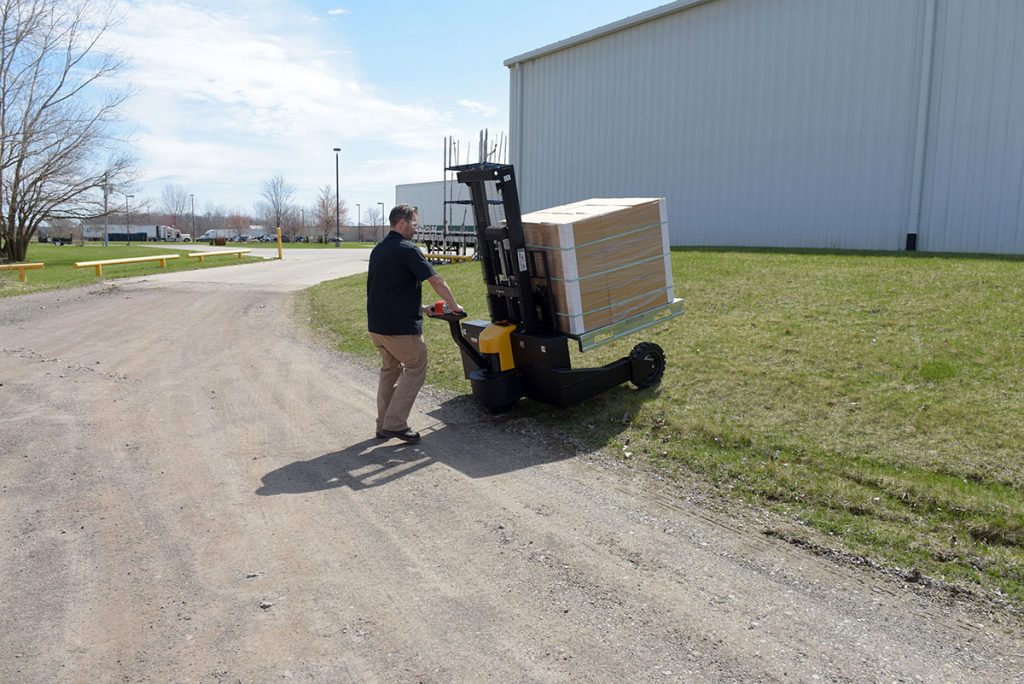
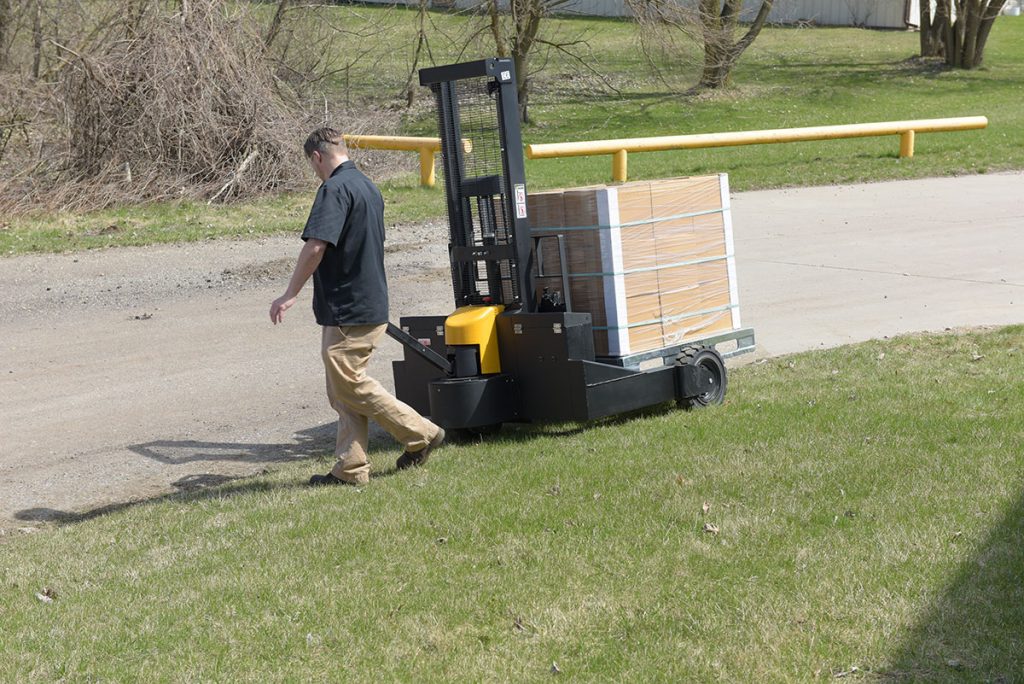
Rough Terrain Stacker—Outdoor Handling Experts

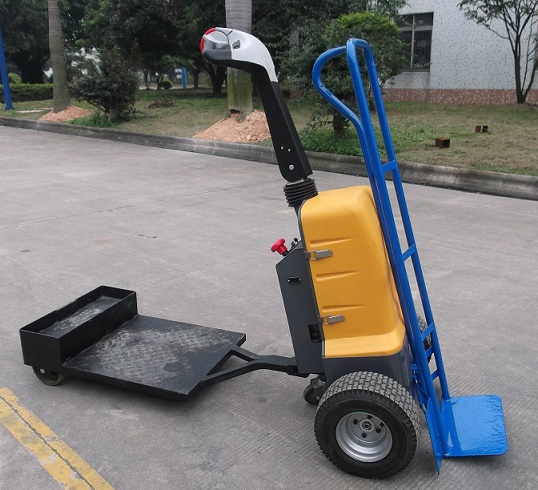
When goods have to be transferred over uneven and rough surfaces, look no further than the electric powered rough terrain stacker. With its large front and back rubber tires this unit can easily be used both indoors and out. 

A multi-function driving handle features an infinite speed adjustment, simple controls for finding the perfect height, and an emergency reverse function. Forks are adjustable to precisely fit what it being maneuvered. And, even more, the unit is equipped with batteries, integral battery charger, and battery level indicator.

Features:

1. Large usable width to transfer a variety of product sizes

2. Diverse height ranges to meet users’ needs

3. Robust capacity to maneuver items, both big and small

4. DC Drive or AC Drive available

5. Wide wheel base for added stability

  If you have this inquiry or demand, please contact with me at any time.

6. The emergency button will automatically cut off the power supply in an emergency to ensure the safety of the driver.

  If you have this inquiry or demand, please contact with me at any time.

The Development Trend of Electric Tow Tractors

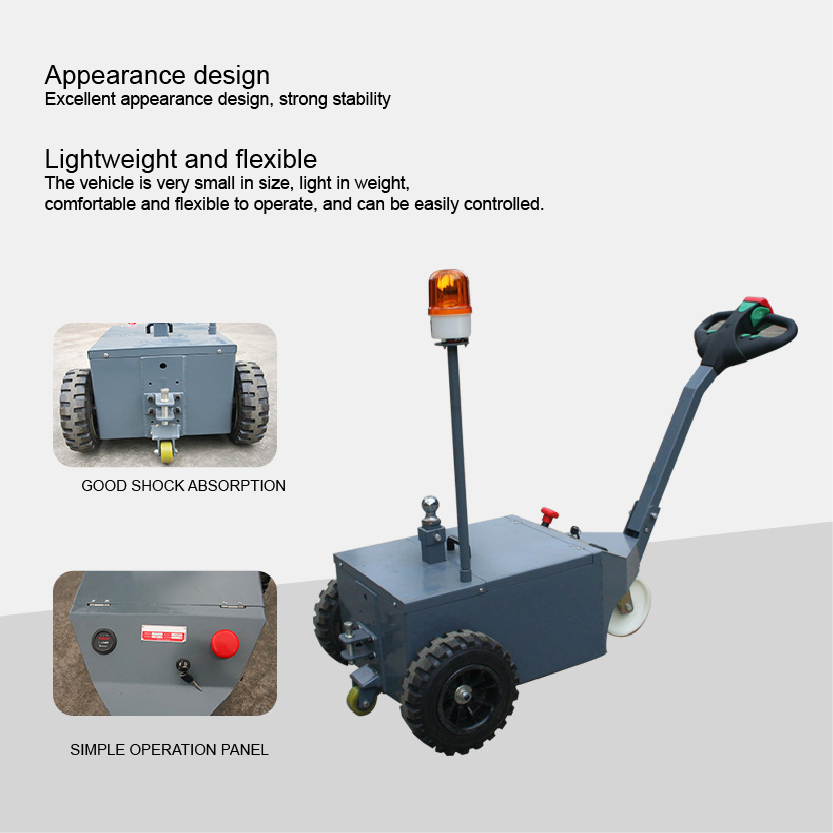
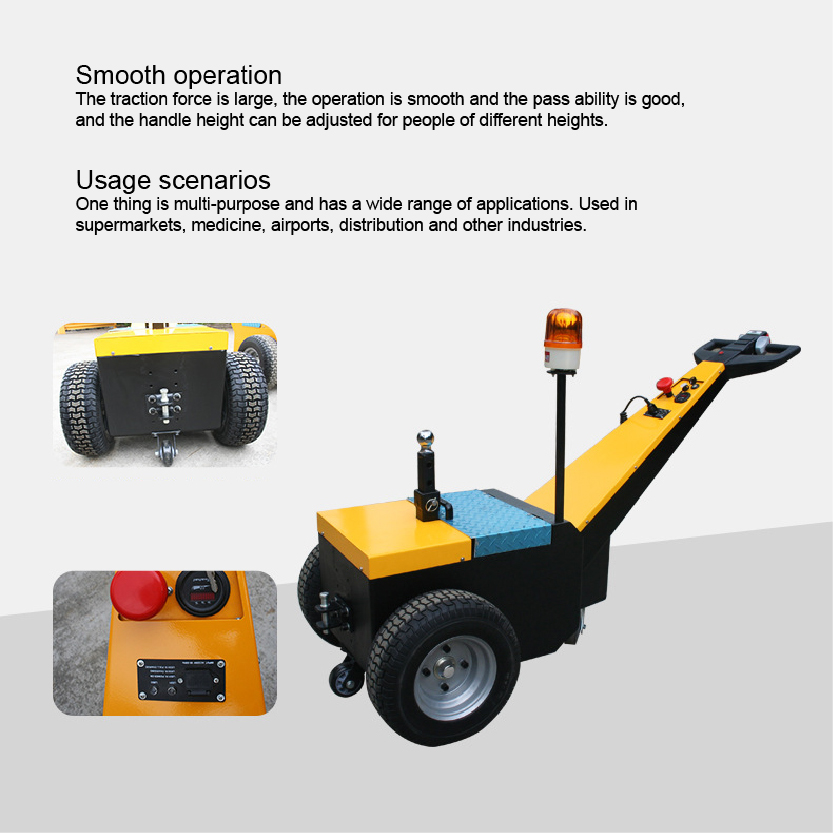
Electric tow tractors are driven by motors and are used for the transportation of large quantities of goods inside and outside the workshop, the handling of assembly line materials, and the material handling between large factories. The materials are often stored in trailers and tow tractors are required to solve the efficient transportation of materials in different intervals. The rated traction load ranges from 1000kg-6000kg.

According to the purpose of the tow tractor, it can be classified into many types such as seated electric tow tractors, stand-on electric tow tractors, mini tractor, electric dual-drive tractor, walk-behind electric tow tractors, electric material tractor and so on.

Features of Electric Tow Tractors:

Electric tow tractors have the advantages of high energy conversion efficiency, low noise, no exhaust emissions, and convenient control. To meet the needs of various logistics transportation and distribution systems, it can significantly improve production efficiency. With the development of the logistics industry and the improvement of environmental protection requirements, the market demand for electric tow tractors is increasing. Wherever countries attach great importance to environmental protection, electric vehicles are very useful. In our country, as environmental governance increases, Electric tow tractors will gradually replace internal combustion tractors in the future.

The development trend of Electric Tow Tractors technology in the following aspects:

  1. The walking motor and its controller are developed from DC technology to AC technology;
  2. The development of vehicle communication in the direction of networking has improved the reliability and communication speed of data communication, reduced the cost of the control system, and greatly improved the control level of electric tow tractors.
  3. Hydraulic power steering replaces mechanical steering technology, which is light and comfortable to operate and has good maneuverability;
  4. The braking system is developing in the direction of hydraulic power braking, with light braking and fast response;
  5. Wet multi-disk brakes instead of dry brakes extend the life of the brakes, increase the braking torque, shorten the braking distance, and improve the braking safety of the entire vehicle.

Wide application of order picker

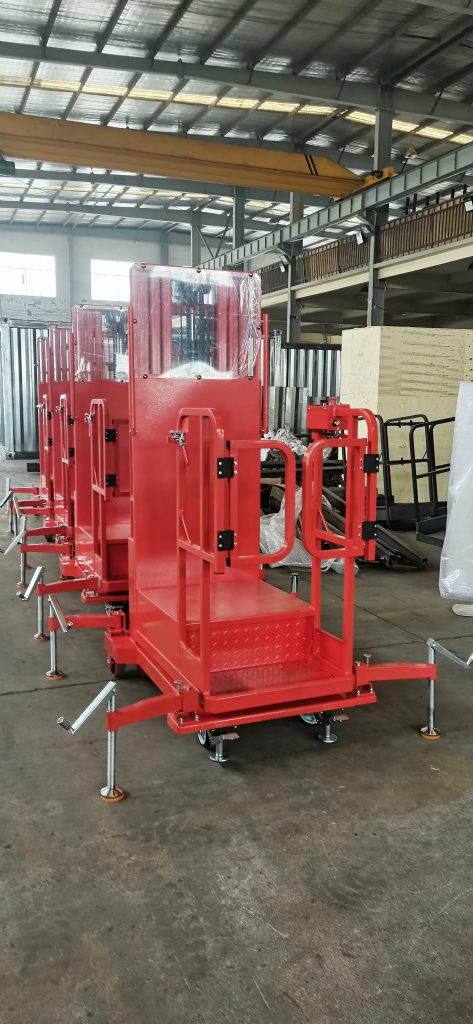
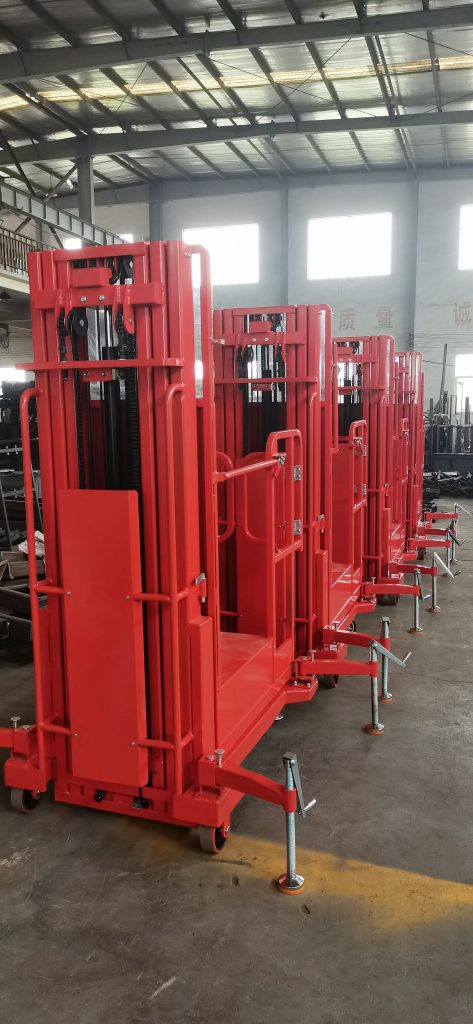
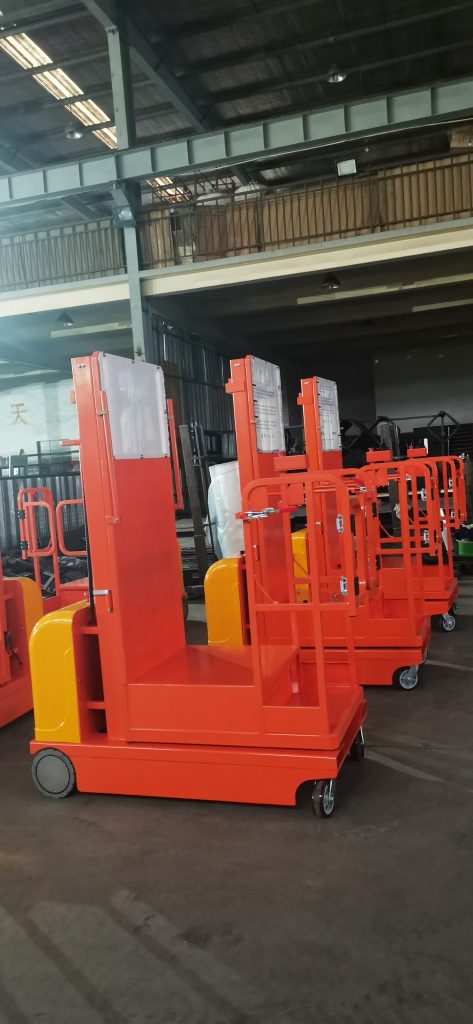
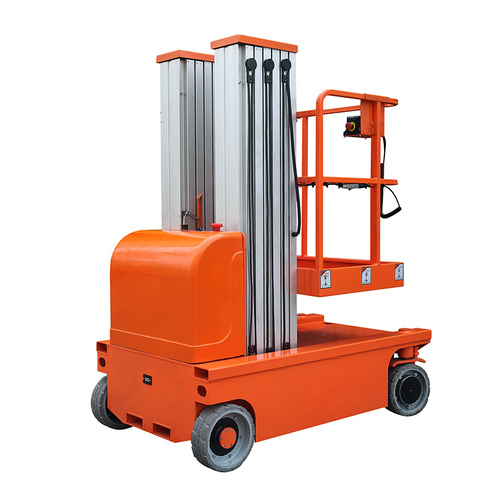
Order picker are widely used in factories, industries, properties, buildings, warehouses, airports, gas stations and other places. Especially It is a good helper for farmers, for example, it can used on the cherries, grapes etc fruits as well as the vegetables’ s picking.

In terms of power supply, it has two main types: Full electric type and Semi electric type.

Main specifications:

Platform load capacity: 300kg

Max. Platform height from 2700mm to 4500mm.

  1. Walking and lifting all by electric.
    The electric order picker can carry 300 kg and lift 2700 to 4500mm.
  2. Spacious operating platform.
    The order picker has a wide operating platform and a high-quality non-slip surface, which embodies good stability and ensures safe operation at high altitude.

Suitable for single person operation.
It is mainly used for picking and placing items in narrow spaces such as warehouses, workshops, elevators, supermarkets, and subway stations.

A Brief History of Lifting Platforms

Do you know? In fact, the demand for vertical transportation of the lifting platform is as long as the human civilization. The earliest lifting platform used manpower, animal power and hydraulic power to lift weight. The lifting device has been relying on these basic power methods until the industrial revolution.

In ancient Greece, Archimedes developed an improved lifting device operated with ropes and pulleys. It used winches and levers to wrap the lifting rope around the bobbin.

In 80 AD, gladiators and wild animals reached the height of the arena in the Roman Coliseum on the original lifting platform.

Medieval records include countless people who lifted the lifting device and patterns for supplying isolated locations. The most famous of these is the lifting platform of the Monastery of St. Baram in Greece. The monastery is located on the top of a mountain about 61 meters above the ground. The hoist uses baskets or cargo nets to transport people and goods up and down.

In 1203, the lifting platform of a monastery located on the French coast was installed using a huge tread wheel. The donkey provided the lifting power. By winding the rope on a huge column, the weight was lifted.

In the 18th century, mechanical force began to be used for the development of lifting platforms. In 1743, French Louis XV authorized the installation of a lifting platform for the use of counterweights in a private palace in Versailles.

In 1833, a system using a reciprocating rod lifted miners in the Harz Mountains region of Germany.

In 1835, a belt-driven lifting platform called a “winch” was installed at a factory in the United Kingdom.

In 1846, the first industrial hydraulic lifting platform appeared. Then other powered lifting devices followed quickly.

In 1854, the American mechanic Otis invented a ratchet mechanism and displayed a safe lifting platform at the New York Trade Fair.

In 1889, when the Eiffel Tower was built, a steam-powered lifting platform was installed, and then the elevator was used.

In 1892, the lifting equipment of Chile ’s Astillero was built. Until now, 15 lifting platforms still use the mechanical equipment more than 110 years ago.

Currently, the “Gotthard Tunnel” under construction in the Canton of Graubünden, Switzerland, is an underground railway tunnel from the Alps ski resort to other European countries. It is 57 kilometers in length and was opened to traffic in 2016. At the “Alps” high-speed train station about 800 meters above the ground, a lifting platform will be built directly to the ground. When completed, it will be the longest lifting platform in the world. After reaching the ground through the lifting platform, passengers can take the Alpine Glacier Sightseeing Express Train and reach the mountain resort in two hours.

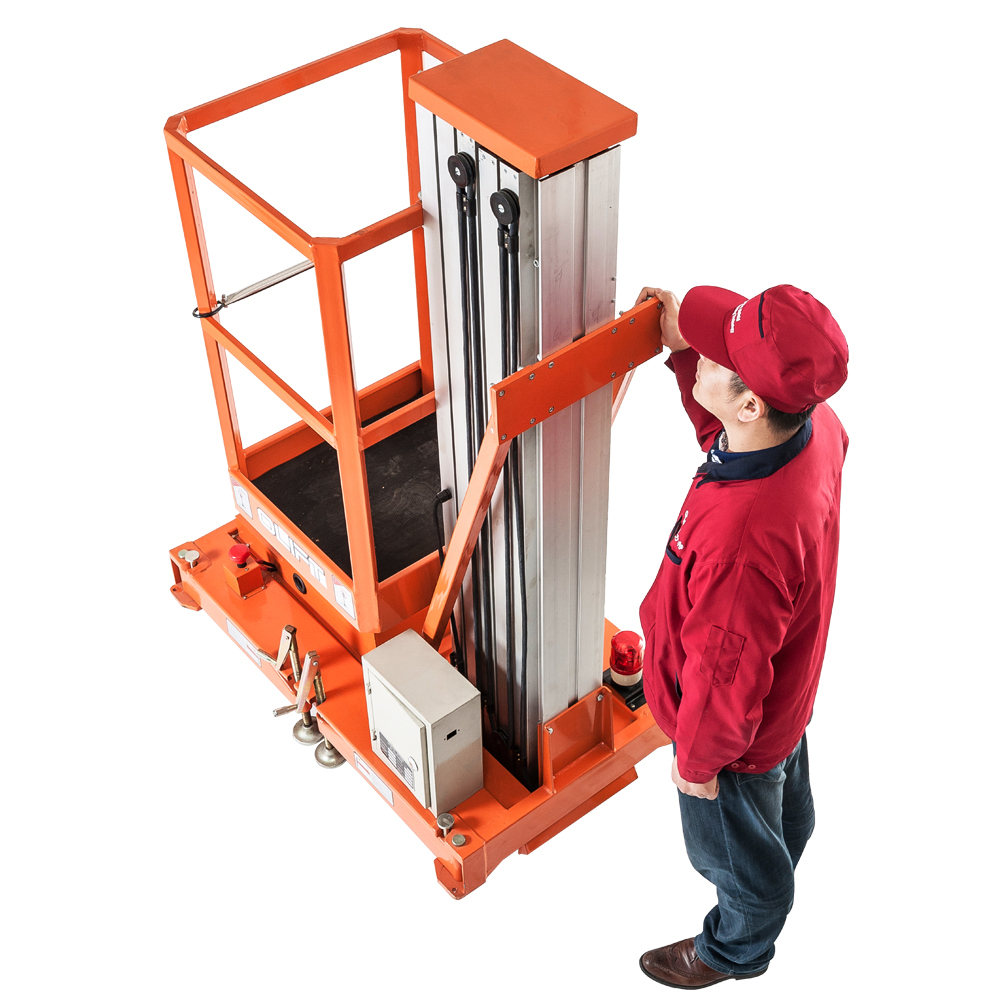
Full electric double mast aluminum alloy lifting platform—PLA
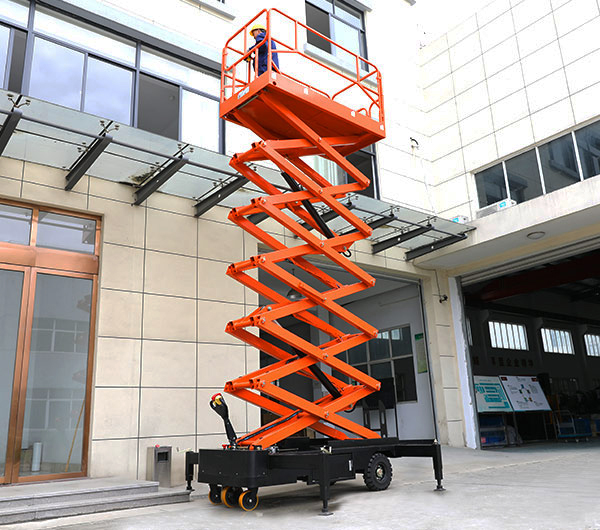
Scissor lifting platform with pulling device

Development history of global industrial vehicle technology

Since the last century, developed countries have begun to use the first logistics vans for cargo handling. Since then, it has created a new era of the world’s material handling industry. It is the originator of modern industrial vehicles.

In 1924, the technical staff of Clark Company invented a forklift that truly has the function of being handled by a fork, that is, “Forklift”-that is, “a forklift has fork to lifting” machinery. The so-called forklifts they manufactured at that time had a relatively different shape from the current forklifts. The forklifts at that time were counter-balance diesel forklifts with rough and ugly shapes. But compared with the current forklift, the forklift also has basic elements such as power, counterweight (that is, balance weight), fork, and lifting cylinder (single cylinder). After the First World War, the forklift trucks invented by Clark Company began to serve all important material handling markets around the world on a large scale. There is no doubt that the forklift first serves military logistics.

Below we briefly describe the development process of global industrial vehicle technology, including many revolutionary events:

In 1917, the American Clark company developed a material handling truck, named Tructractor, is the pioneer of diesel forklift.

In 1924, Clark designed a standard forklift, named Duat, which was first used in the US military.

In 1925, the United States Yale (Yale) launched the first commercial battery-powered forklift.

In 1943, the German Steinbock company produced the first electric three-point forklift in Europe.

In 1947, the Swedish BT company manufactured the first manual pallet forklift.

In 1951, the German Steinbock company produced the first off-road forklift.

In 1953, the “AGV”, a transportation tool invented by individuals for unmanned operation, was launched.

In 1957, Linde (Germany) produced the first static pressure driven forklift.

In 1958, the Swedish Atlet company was established, producing electric stacker for the first time.

In 1963, Germany’s Steinbock built the world’s fastest forklift. (50km / h).

In 1969, Moffet produced the first truck-mounted forklift.

In 1973, the British company Pyroban applied the explosion-proof technology to the forklift for the first time.

In 1981, Merlo of Italy and Manitou of France launched the first telescopic forklift at the same time.

In 1985, Kalmar produced the first container crane.

In 1996, the American Airtrax Company applied the universal wheel technology obtained from Sweden to the forklift truck, launched the “universal walking forklift” and “universal lifting platform”, and served the US military aircraft carrier.

In 1998, the German Stocklin forklift company produced the first AC electric forklift, and Germany Baumann manufactured the world’s largest electric side forklift (30 tons).
In 2006, the United States Intermec and Cascade (Cascade) jointly developed a conceptual RFID forklift (RFID is the abbreviation of Radio Frequency Identification, that is, radio frequency identification, commonly known as electronic tags).

In 2008, Still and Toyota launched hybrid forklifts. Toyota and Linde launched hydrogen-powered forklifts. Jungheinrich launches a methanol fuel cell forklift.